

Pet insurance for pre-existing conditions: What Fetch covers
Does pet insurance cover pre-existing conditions?
Fetch does not cover all pre-existing conditions — no pet insurance does. These are injuries, illnesses or conditions your pet had before you signed up or during your policy’s waiting period of up to 15 days. Keep reading to learn more, including how Fetch is one of just a few insurers that covers curable pre-existing conditions.

Mars
Fetch Member since 2021
Pre-existing conditions defined: What you need to know
Unlike human health insurance, pet insurance doesn’t cover pre-existing conditions. A pre-existing condition is any injury, illness or health condition that you or your veterinarian notice your pet has either before you sign up for Fetch, before your policy’s effective date or during your waiting period of up to 15 days.
How do pet insurance providers know your pet has a pre-existing condition?
Most insurers require you to submit your pet's veterinary medical records to process your claims. Those records show your pet’s medical history and help providers determine what is eligible for coverage and what’s considered a pre-existing condition. Fetch asks that you submit your pet’s medical records for the 1 year prior to signing up. We can also get them for you if you give us your vet’s contact info. If you’ve had your pet for less than a year, simply submit the records from any vet visits you’ve had.
If you didn't go to the vet prior to signing up, no problem. Just schedule a checkup, and submit your medical records after it. If your pet receives a clean bill of health, Fetch will cover all future accidents and illnesses your pet may encounter throughout their life. If the checkup uncovers any medical issues, those conditions won’t be covered.

Any medical condition that occurs before your waiting period ends is not covered
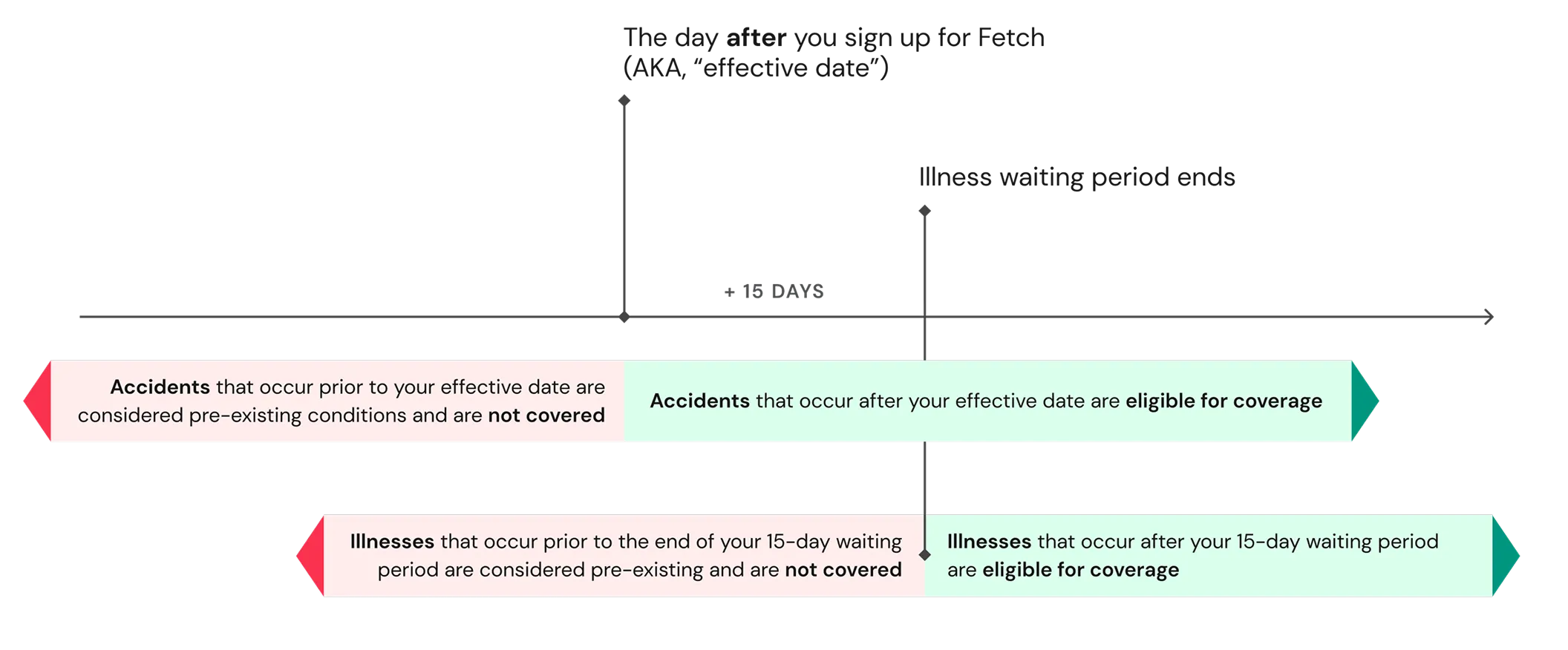
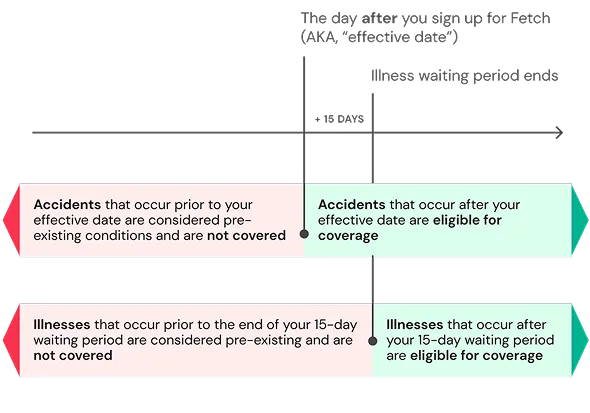
Knowing if your pet has a pre-existing condition or not starts with understanding when your accident and illness coverage begins. For accidents (think: injuries like broken bones, scratches and poisoning): Your pet is covered if the accident occurs on or after your policy’s effective date (1 day after you sign up). There is no waiting period for accidents. For illnesses (think: vomiting, allergies and dental disease): Coverage begins after the waiting period of up to 15 days. The waiting period begins on your policy’s effective date.
Coverage 101: When does your accident & illness waiting period end?
A few examples of pre-existing conditions in dogs & cats

Allergies
Your puppy is excessively licking his paws, so you take him to the vet even though you don’t have pet insurance. Later, after this visit, you purchase a policy with Fetch. The paw-licking continues and now he’s getting skin infections, so you take another trip to the vet. Your vet diagnoses him with allergies. Since the clinical signs appeared before your policy with us, allergies would be a pre-existing condition and not covered.

Fractures
Your kitten was limping on the right front leg before you got pet insurance, and your vet couldn’t identify the cause. After the policy waiting period of up to 15 days, your kitten starts limping again on the same leg. Your vet takes an X-ray and diagnoses her with a fracture. Since the limping was observed prior to purchasing a policy, the fracture would be a pre-existing condition and not covered.

Jessica & Quinn
Fetch Members since 2022

Torn ligaments
Your dog accidentally injured the cruciate ligament in her right knee before you signed up for pet insurance with Fetch. A year into the policy, the ligament is completely torn. Because the accident occurred before you purchased the policy, the tear would be considered pre-existing. With orthopedic bilateral conditions, your pet runs a higher risk of the same condition happening on the other side of her body, and future occurrences (such as a cruciate tear on the left side) would be a pre-existing condition and not covered.

Theodore & Alex
Fetch Members since 2020
Accidents happen — cover your pet before it becomes a pre-existing condition
The earlier you enroll with Fetch, the sooner your dog or cat is covered should they get sick or hurt in the future. That helps pet parents give their best friend a longer, healthier life and make unexpected vet bills more affordable.

Nearly 1 in 4 pet parents are stressed about a $250 veterinary expense
per the AAHA (American Animal Hospital Association), with unexpected emergencies among the top concerns.

The cost of veterinary care has gone up by more than 60% over the past decade
according to the New York Times. Pet insurance can help manage those costs when your pet gets sick or hurt.

Any veterinary emergency can “easily result in a bill greater than $2,000,”
according to the AVMA (American Veterinary Medical Association).
Unlike others, Fetch covers curable pre-existing conditions to help give your pet a longer, healthier life
What is a curable pre-existing condition?
Curable pre-existing conditions are medical conditions that can be completely cured with no recurrence of signs or symptoms. Think: urinary tract infections, upper respiratory infections, bite wounds and conjunctivitis.
How does Fetch decide a pre-existing condition is curable?
In order for the condition to be considered curable, your pet must go 1 year completely symptom-free from the issue. It can be during the first or the second year after you sign up.
How it works
Year 1 after you sign up for Fetch
If your pet goes the entire first year of your policy without showing any signs or symptoms of that previous condition and without needing treatment for it, Fetch will cover it moving forward. Just make sure you take your pet in for an annual vet exam after that first year ends and before the condition ever comes back.
Year 2 after you sign up for Fetch
If the condition does come back during the first year of your policy, your pet has a second chance. If your pet goes the entire second year of your policy without showing any signs or symptoms of that previous condition and without needing treatment for it, Fetch will cover it moving forward. Just make sure you take your pet in for an annual vet exam after that first year ends and before the condition ever comes back.

If the condition comes back during that second year of your policy, it will be classified as a permanent pre-existing condition, and it will be excluded from coverage.
Examples of curable and incurable pre-existing conditions:
Curable
Curable pre-existing conditions are medical conditions that can be completely cured with no recurrence of signs or symptoms.

Urinary tract infection
Upper respiratory infection
Soft tissue injury
Burn
Bite wound
Conjunctivitis
Broken nail
Infected wound
Infected tear ducts
Swollen paw
Ear infection
Diarrhea
Pneumonia
Hot spot
Incurable
Incurable pre-existing conditions are medical issues that can’t be completely cured, or come back during the first 2 years of your policy.

Torn ligament
Allergies
Chipped bone
Ruptured intervertebral disc
Arthritis
Spinal compression
Bone marrow disease
Elbow dysplasia
Metabolic disorders
Diabetes
Hyperthyroidism (overactive thyroid)
Hypothyroidism (underactive thyroid)

The most common ailments dogs and cats of all breeds experience are gastrointestinal issues, urinary tract infections and ear infections, according to NAPHIA (North American Pet Health Insurance Association). Fetch covers these and other curable pre-existing conditions. Not all providers do.
Fetch Wellness keeps your pet healthy with routine & preventive care
Fetch Pet Insurance gives you unmatched coverage when your pet is sick or hurt. Add Fetch Wellness, and you'll also be covered for the routine care that helps keep them healthy. With both, you'll be better prepared for your pet's veterinary needs, plus you'll save big on vet bills.
Our Wellness plan covers preventive treatment like vaccines and routine care like annual exams and dental cleanings.
Learn more about Fetch Wellness


Your questions about coverage for pre-existing conditions & pet insurance — answered
How do I know if my pet has a pre-existing condition?


Does Fetch Pet Insurance cover curable pre-existing conditions?
Can I get Fetch Pet Insurance after my pet has been diagnosed with a condition?
Is pet insurance worth it if my pet already has a pre-existing condition?
Are breed-specific issues the same as pre-existing conditions?
How does Fetch Pet Insurance determine what is a pre-existing condition?
What is the difference between curable and incurable pre-existing conditions in pet insurance?